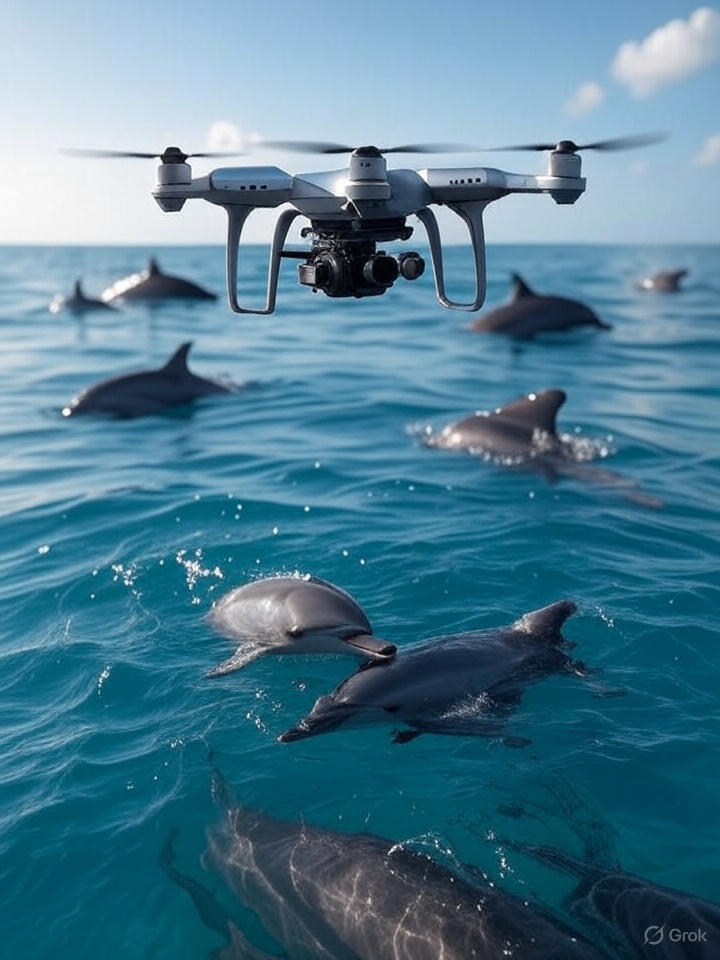
1. Drones Reveal Secrets of Humpback Dolphins' Mating Behavior
Summary: Scientists in India first used drones to study the courtship and mating behavior of rare humpback dolphins. The revolutionary methodology allowed obtaining unique data without interfering with the natural habitat.
News: Off the coast of Kochi (India), scientists captured unique footage of courtship and mating games of Indian humpback dolphins (Sousa plumbea) using modern drones. Researchers from the Marine Biological Institute of India applied an innovative observation methodology that allowed studying the behavior of this rare marine mammal species without disturbing the animals in their natural environment.
The obtained data revealed complex social interactions between individuals during the mating period, including synchronized jumps, playful elements, and special acoustic signals. The research opens new horizons for non-invasive methods of studying marine mammals and could become the foundation for developing protection programs for this vulnerable species.
The work is published in the international journal Marine Mammal Science and has already attracted attention from the global scientific community as a breakthrough in dolphin behavior studies.
Keywords for digest: dolphins, India, Sousa plumbea, drones, mating behavior, science, ecology
2. Dolphins Return to the Gulf of Finland
Summary: Bottlenose dolphins were spotted near Zelenogorsk close to St. Petersburg, indicating improvement in the ecological situation of the Gulf of Finland. The return of marine mammals became an unexpected event for the region.
News: Residents and scientists recorded the appearance of a group of bottlenose dolphins in the waters of the Gulf of Finland near Zelenogorsk. This rare event for the region may indicate significant restoration of water quality and increase in the food base in the gulf.
According to specialists from the Zoological Institute of the Russian Academy of Sciences, bottlenose dolphins were last massively observed in these waters more than 30 years ago. The improvement in the ecological situation is attributed to the implementation of wastewater treatment programs, reduction of industrial emissions, and restoration of fish populations.
Marine biologists urge regional residents to exercise caution when observing dolphins and not to approach the animals at close distance. The return of marine mammals is an important indicator of ecosystem health and the result of long-term environmental efforts in the region.
Keywords for digest: dolphins, Gulf of Finland, St. Petersburg, ecology, nature restoration, bottlenose dolphins
Summary: Scientists in India first used drones to study the courtship and mating behavior of rare humpback dolphins. The revolutionary methodology allowed obtaining unique data without interfering with the natural habitat.
News: Off the coast of Kochi (India), scientists captured unique footage of courtship and mating games of Indian humpback dolphins (Sousa plumbea) using modern drones. Researchers from the Marine Biological Institute of India applied an innovative observation methodology that allowed studying the behavior of this rare marine mammal species without disturbing the animals in their natural environment.
The obtained data revealed complex social interactions between individuals during the mating period, including synchronized jumps, playful elements, and special acoustic signals. The research opens new horizons for non-invasive methods of studying marine mammals and could become the foundation for developing protection programs for this vulnerable species.
The work is published in the international journal Marine Mammal Science and has already attracted attention from the global scientific community as a breakthrough in dolphin behavior studies.
Keywords for digest: dolphins, India, Sousa plumbea, drones, mating behavior, science, ecology
2. Dolphins Return to the Gulf of Finland
Summary: Bottlenose dolphins were spotted near Zelenogorsk close to St. Petersburg, indicating improvement in the ecological situation of the Gulf of Finland. The return of marine mammals became an unexpected event for the region.
News: Residents and scientists recorded the appearance of a group of bottlenose dolphins in the waters of the Gulf of Finland near Zelenogorsk. This rare event for the region may indicate significant restoration of water quality and increase in the food base in the gulf.
According to specialists from the Zoological Institute of the Russian Academy of Sciences, bottlenose dolphins were last massively observed in these waters more than 30 years ago. The improvement in the ecological situation is attributed to the implementation of wastewater treatment programs, reduction of industrial emissions, and restoration of fish populations.
Marine biologists urge regional residents to exercise caution when observing dolphins and not to approach the animals at close distance. The return of marine mammals is an important indicator of ecosystem health and the result of long-term environmental efforts in the region.
Keywords for digest: dolphins, Gulf of Finland, St. Petersburg, ecology, nature restoration, bottlenose dolphins