Introduction: The God of Seas and His Noble Companions
For millennia, dolphins have occupied a special place in human culture, mythology, and art. They appear on the frescoes of ancient palaces, are carved in stone on the world's greatest architectural monuments, and are described in legends and epics. But what makes the dolphin such a significant symbol? The answer lies in ancient myths about Neptune—the Roman god of the seas, whose dolphins served as mediators between the divine and earthly worlds.
Today, as Neptune enters the sign of Aries on January 26, 2026, we invite you to embark on a journey through the centuries to understand the profound connection between the sea god and these remarkable creatures. This is a journey from ancient mythology to modern movements for the protection of marine ecosystems, embodied in the work of the global platform Dolphin Hub.
I. Neptune in Ancient Mythology: The King of the Seas and His Messengers
Poseidon and Neptune: Masters of the Aquatic Elements
Neptune is the Roman name for the Greek deity Poseidon, the lord of the seas, oceans, earthquakes, and storms. In ancient mythology, Neptune holds the trident—a symbol of his absolute power over all waters of the Earth. Initially, in Roman religion, Neptune was revered as the god of springs and streams, but under the influence of Greek culture, he became the ruler of all maritime realms.
The image of Poseidon in Greek tradition was complex and multifaceted: he was a fearsome god who caused storms and earthquakes, punishing mortals for their arrogance and disrespect. Yet simultaneously, he was the protector of sailors, the creator of horses, and, most importantly for us, the patron of dolphins.
Dolphins as Messengers of Poseidon: Legends of Rescue and Love
According to one of the most famous Greek legends, when Poseidon fell in love with the beautiful nymph Amphitrite, he sent a dolphin as a messenger of his affection. The eloquent and intelligent dolphin spoke so persuasively of the sea god's feelings that Amphitrite consented to marry Poseidon. In gratitude for his assistance, the god placed the dolphin's image eternally in the celestial vault, creating the constellation Delphinus.
This mythological story is deeply symbolic: the dolphin appears not merely as an animal, but as a mediator between worlds, as an embodiment of beauty, intelligence, and the capacity for dialogue. The dolphin becomes a symbol of harmony between power (Poseidon) and feeling (Amphitrite), between marine might and feminine grace.
Another famous legend tells of the lyricist Arion. When treacherous sailors attempted to throw the musician into the sea for his gold, a dolphin, enchanted by Arion's heavenly music, caught him and saved him from certain death. This story symbolizes the redemptive power of art and beauty—the capacity of creativity to touch the hearts of wild creatures and bring miraculous salvation.
Dolphins as Protectors and Saviors
In Greek mythology, dolphins repeatedly served as rescuers of drowning people. They were perceived not as ordinary animals, but as earthly manifestations of divine grace, as helpers of the gods in protecting human lives. This perception became deeply rooted in the consciousness of ancient Greeks and Romans, making the dolphin a symbol of hope, salvation, and nobility.
II. Dolphins in Ancient Civilizations: Sacred Animal and Symbol of Status
The Cretan-Minoan Civilization: The Dolphin as Divine Symbol
Some of the most ancient depictions of dolphins in European art are found on Crete. Frescoes from the Palace of Knossos (16th century BCE) feature beautifully executed scenes of dolphins leaping over waves. These images testify to the deep reverence for dolphins in Minoan civilization.
For the Cretans, the dolphin was a sacred animal that brought good fortune and protected seafarers. Dolphins adorned pottery, frescoes, jewelry, and everyday objects. They symbolized the wealth of maritime trade routes, the power of the sea, and equally, the harmony between humans and the marine world.
Ancient Rome: The Dolphin as Symbol of Power and Prosperity
In Ancient Rome, the dolphin became a popular motif in mosaics, sculptures, reliefs, and coins. Mosaics featuring dolphins adorned the villas of wealthy citizens, emphasizing their connection to the sea and their standing in high society. The dolphin symbolized nobility, intelligence, prosperity, and connection with higher divine forces.
On coins and seals, the dolphin was often depicted alongside Neptune's trident, reinforcing the association between the sea god and this noble marine mammal. This was an expression of divine patronage over maritime trade and the naval power of the empire.
III. Dolphins in Medieval and Renaissance Art: Revival of Classical Forms
The Renaissance: The Return to the Grandeur of Ancient Images
The Renaissance brought a revival of interest in classical mythology and the images of the ancient world. Artists, sculptors, and architects turned to the dolphin as a symbol of beauty, wisdom, and connection with the divine.
Famous Renaissance fountains often featured dolphin sculptures. The Fountain of Neptune in Bologna, the work of Tommaso Lamparoni, is a striking example of the synthesis of classical mythology and architectural mastery. Neptune's trident and his marine companions—the dolphins—create a unified composition expressing power, beauty, and divine harmony.
Peterhof: The Triumph of Neptune in Russian Imperial Culture
However, when discussing fountains with dolphins in European architecture, one cannot overlook the Peterhof Palace—one of the greatest monuments of 18th-century architectural and landscape art. Peterhof, created by the will of Peter the Great as the "Russian Versailles," embodies a synthesis of Italian and French traditions with Russian imperial grandeur.
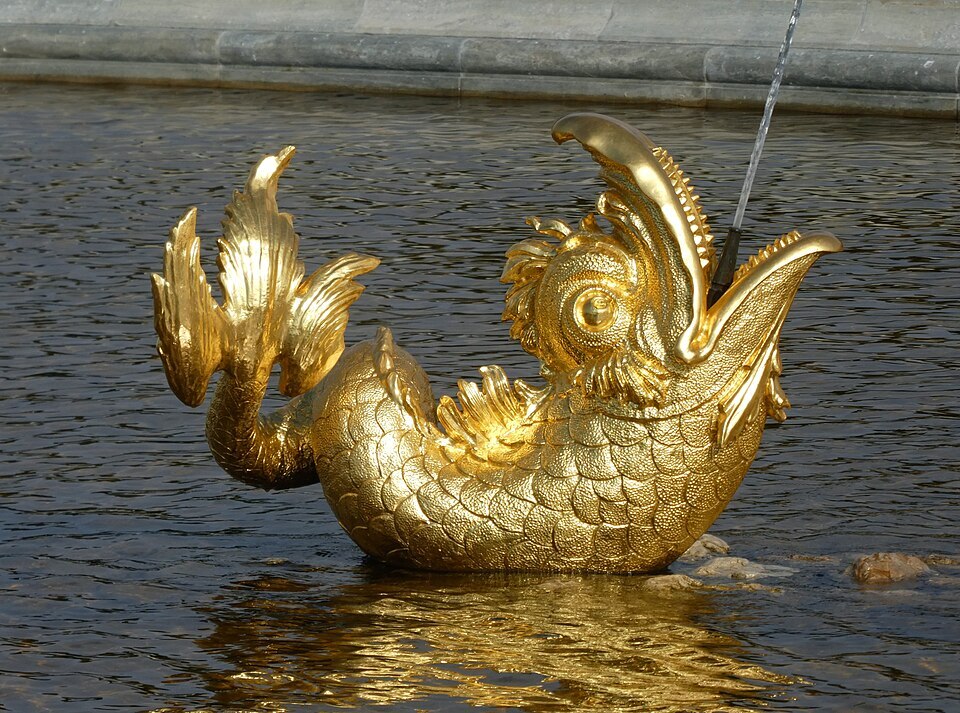
The celebrated Peterhof fountains are adorned with dolphin sculptures that serve not merely as decorative elements, but as symbols of Russia's maritime power, its connection to the Baltic Sea, and its ambitions as a great seafaring nation. The gilded dolphins of Peterhof, spouting streams of water amid mythological scenes, express the fusion of human genius with the forces of nature and the divine authority of the sea gods.
The cascading Peterhof fountains, including the famous cascade fountain, testify to how classical mythology became organically woven into the fabric of Russian imperial culture. The dolphins of Peterhof became symbols not only of aesthetic beauty and high art, but also of state grandeur, Russia's connection to the seas, and its ambitions as a maritime power.
IV. Dolphins in Contemporary Art and Culture: From Symbol to Action
The 20th–21st Centuries: Ecology and Creativity
In the 20th century, growing interest in ecology and the protection of marine life led to a transformation of the dolphin's image in art and culture. Contemporary artists use the dolphin not only as an aesthetic symbol but as a powerful tool for social education and ecological awareness.
Sculptures and installations dedicated to dolphins appear in museums, parks, and public spaces worldwide. They serve not only as works of art but as means of communication, evoking reflections on humanity's place in the biosphere and the necessity of protecting marine ecosystems.
Literature and Poetry: The Dolphin as an Embodiment of Wisdom
In literature, the dolphin often appears as a symbol of wisdom, compassion, beauty, and connection between species. From ancient epics to contemporary poetry, from science fiction to ecological prose, the dolphin occupies a special place in the imaginations of writers.
The dolphin image is used to explore profound philosophical and ecological questions: the interaction between humans and nature, the nature of intelligence, self-knowledge, and spiritual development.
V. Neptune in Aries: Astrological Context and Cultural Significance
The Symbolism of the Ingress: A New Wave of Consciousness
On January 26, 2026, Neptune enters the sign of Aries—an event that occurs approximately once every 165 years. Aries is the sign of initiative, courage, new beginnings, and pioneering spirit. When Neptune, the planet of dreams, creativity, and intuition, enters this energetic and active sign, a unique symbolic context emerges.
This ingress portends a period when dreams strive to manifest into concrete actions, when creativity receives a new, more active form of expression. For movements dedicated to dolphin protection and marine ecosystem preservation, this time symbolizes the awakening of a new wave of consciousness—active, creative, courageous, and purposeful.
Mythological Synthesis: From Passivity to Action
Neptune has always been associated with the depths of the unconscious, creative impulses, intuition, and spirituality. Aries, by contrast, symbolizes conscious action, will, physical manifestation, and fighting spirit. This meeting points to a critical moment of transition from passive understanding of our relationship with the sea to an active, creative, and courageous reconceptualization of that connection.
Dolphins, having served for centuries as symbols of harmony between humans and nature, may once again assume the role of symbols of active cooperation, creative dialogue, and courageous protection of the marine worlds.
VI. Dolphin Hub: The Modern Embodiment of an Ancient Myth
Science, Ecology, and Culture in Unity
Dolphin Hub is a global platform for human-dolphin interaction, uniting science, ecology, and culture. Here, the mythological principles of ancient Neptune meet contemporary knowledge and technology.
On Dolphin Hub, dolphins are studied by scientists, protected by ecologists, and inspire artists. They become living ambassadors of the ancient gods, reminding us of our participation in a greater whole—a planet we share with countless other beings.
Community as a Continuation of Ancient Tradition
The community of dolphin enthusiasts gathered on Dolphin Hub continues the tradition of Poseidon and Neptune, revering these noble sea creatures and striving to create harmony between human civilization and the marine world.
Through scientific research, educational programs, cultural projects, and practical initiatives, Dolphin Hub embodies an ancient principle: the dolphin is not merely an animal, but a mediator between humanity and the divine world of nature, a symbol of harmony, wisdom, and the necessity of action.
VII. Conclusion: From Legend to Responsibility
Neptune's ingress into Aries is a symbolic moment that invites humanity to reconsider its relationship with the sea, its inhabitants, and the deep layers of our own consciousness.
Dolphins—companions of Poseidon, saviors of Arion, heroes of a thousand legends and works of art—remain for us symbols of hope, intelligence, beauty, and the possibility of harmonious coexistence of different species on one planet.
Through mythology, art, and culture, we understand that caring for dolphins is caring for our humanity, for our capacity for compassion and creativity, for the planet that gives us the breath of life.
In this critical moment, let the image of the dolphin remind us of the necessity of bold actions (the energy of Aries) to protect marine worlds and develop our creative potential (the gift of Neptune). Let this be the beginning of a new era, when ancient myths come alive in concrete deeds of ocean conservation.
Join Dolphin Hub, the global movement for the protection of dolphins and marine ecosystems. Become part of a story that began with ancient gods and continues in your actions here and now.
Poseidon and Neptune: Masters of the Aquatic Elements
Neptune is the Roman name for the Greek deity Poseidon, the lord of the seas, oceans, earthquakes, and storms. In ancient mythology, Neptune holds the trident—a symbol of his absolute power over all waters of the Earth. Initially, in Roman religion, Neptune was revered as the god of springs and streams, but under the influence of Greek culture, he became the ruler of all maritime realms.
The image of Poseidon in Greek tradition was complex and multifaceted: he was a fearsome god who caused storms and earthquakes, punishing mortals for their arrogance and disrespect. Yet simultaneously, he was the protector of sailors, the creator of horses, and, most importantly for us, the patron of dolphins.
Dolphins as Messengers of Poseidon: Legends of Rescue and Love
According to one of the most famous Greek legends, when Poseidon fell in love with the beautiful nymph Amphitrite, he sent a dolphin as a messenger of his affection. The eloquent and intelligent dolphin spoke so persuasively of the sea god's feelings that Amphitrite consented to marry Poseidon. In gratitude for his assistance, the god placed the dolphin's image eternally in the celestial vault, creating the constellation Delphinus.
This mythological story is deeply symbolic: the dolphin appears not merely as an animal, but as a mediator between worlds, as an embodiment of beauty, intelligence, and the capacity for dialogue. The dolphin becomes a symbol of harmony between power (Poseidon) and feeling (Amphitrite), between marine might and feminine grace.
Another famous legend tells of the lyricist Arion. When treacherous sailors attempted to throw the musician into the sea for his gold, a dolphin, enchanted by Arion's heavenly music, caught him and saved him from certain death. This story symbolizes the redemptive power of art and beauty—the capacity of creativity to touch the hearts of wild creatures and bring miraculous salvation.
Dolphins as Protectors and Saviors
In Greek mythology, dolphins repeatedly served as rescuers of drowning people. They were perceived not as ordinary animals, but as earthly manifestations of divine grace, as helpers of the gods in protecting human lives. This perception became deeply rooted in the consciousness of ancient Greeks and Romans, making the dolphin a symbol of hope, salvation, and nobility.
II. Dolphins in Ancient Civilizations: Sacred Animal and Symbol of Status
The Cretan-Minoan Civilization: The Dolphin as Divine Symbol
Some of the most ancient depictions of dolphins in European art are found on Crete. Frescoes from the Palace of Knossos (16th century BCE) feature beautifully executed scenes of dolphins leaping over waves. These images testify to the deep reverence for dolphins in Minoan civilization.
For the Cretans, the dolphin was a sacred animal that brought good fortune and protected seafarers. Dolphins adorned pottery, frescoes, jewelry, and everyday objects. They symbolized the wealth of maritime trade routes, the power of the sea, and equally, the harmony between humans and the marine world.
Ancient Rome: The Dolphin as Symbol of Power and Prosperity
In Ancient Rome, the dolphin became a popular motif in mosaics, sculptures, reliefs, and coins. Mosaics featuring dolphins adorned the villas of wealthy citizens, emphasizing their connection to the sea and their standing in high society. The dolphin symbolized nobility, intelligence, prosperity, and connection with higher divine forces.
On coins and seals, the dolphin was often depicted alongside Neptune's trident, reinforcing the association between the sea god and this noble marine mammal. This was an expression of divine patronage over maritime trade and the naval power of the empire.
III. Dolphins in Medieval and Renaissance Art: Revival of Classical Forms
The Renaissance: The Return to the Grandeur of Ancient Images
The Renaissance brought a revival of interest in classical mythology and the images of the ancient world. Artists, sculptors, and architects turned to the dolphin as a symbol of beauty, wisdom, and connection with the divine.
Famous Renaissance fountains often featured dolphin sculptures. The Fountain of Neptune in Bologna, the work of Tommaso Lamparoni, is a striking example of the synthesis of classical mythology and architectural mastery. Neptune's trident and his marine companions—the dolphins—create a unified composition expressing power, beauty, and divine harmony.
Peterhof: The Triumph of Neptune in Russian Imperial Culture
However, when discussing fountains with dolphins in European architecture, one cannot overlook the Peterhof Palace—one of the greatest monuments of 18th-century architectural and landscape art. Peterhof, created by the will of Peter the Great as the "Russian Versailles," embodies a synthesis of Italian and French traditions with Russian imperial grandeur.
The celebrated Peterhof fountains are adorned with dolphin sculptures that serve not merely as decorative elements, but as symbols of Russia's maritime power, its connection to the Baltic Sea, and its ambitions as a great seafaring nation. The gilded dolphins of Peterhof, spouting streams of water amid mythological scenes, express the fusion of human genius with the forces of nature and the divine authority of the sea gods.
The cascading Peterhof fountains, including the famous cascade fountain, testify to how classical mythology became organically woven into the fabric of Russian imperial culture. The dolphins of Peterhof became symbols not only of aesthetic beauty and high art, but also of state grandeur, Russia's connection to the seas, and its ambitions as a maritime power.
IV. Dolphins in Contemporary Art and Culture: From Symbol to Action
The 20th–21st Centuries: Ecology and Creativity
In the 20th century, growing interest in ecology and the protection of marine life led to a transformation of the dolphin's image in art and culture. Contemporary artists use the dolphin not only as an aesthetic symbol but as a powerful tool for social education and ecological awareness.
Sculptures and installations dedicated to dolphins appear in museums, parks, and public spaces worldwide. They serve not only as works of art but as means of communication, evoking reflections on humanity's place in the biosphere and the necessity of protecting marine ecosystems.
Literature and Poetry: The Dolphin as an Embodiment of Wisdom
In literature, the dolphin often appears as a symbol of wisdom, compassion, beauty, and connection between species. From ancient epics to contemporary poetry, from science fiction to ecological prose, the dolphin occupies a special place in the imaginations of writers.
The dolphin image is used to explore profound philosophical and ecological questions: the interaction between humans and nature, the nature of intelligence, self-knowledge, and spiritual development.
V. Neptune in Aries: Astrological Context and Cultural Significance
The Symbolism of the Ingress: A New Wave of Consciousness
On January 26, 2026, Neptune enters the sign of Aries—an event that occurs approximately once every 165 years. Aries is the sign of initiative, courage, new beginnings, and pioneering spirit. When Neptune, the planet of dreams, creativity, and intuition, enters this energetic and active sign, a unique symbolic context emerges.
This ingress portends a period when dreams strive to manifest into concrete actions, when creativity receives a new, more active form of expression. For movements dedicated to dolphin protection and marine ecosystem preservation, this time symbolizes the awakening of a new wave of consciousness—active, creative, courageous, and purposeful.
Mythological Synthesis: From Passivity to Action
Neptune has always been associated with the depths of the unconscious, creative impulses, intuition, and spirituality. Aries, by contrast, symbolizes conscious action, will, physical manifestation, and fighting spirit. This meeting points to a critical moment of transition from passive understanding of our relationship with the sea to an active, creative, and courageous reconceptualization of that connection.
Dolphins, having served for centuries as symbols of harmony between humans and nature, may once again assume the role of symbols of active cooperation, creative dialogue, and courageous protection of the marine worlds.
VI. Dolphin Hub: The Modern Embodiment of an Ancient Myth
Science, Ecology, and Culture in Unity
Dolphin Hub is a global platform for human-dolphin interaction, uniting science, ecology, and culture. Here, the mythological principles of ancient Neptune meet contemporary knowledge and technology.
On Dolphin Hub, dolphins are studied by scientists, protected by ecologists, and inspire artists. They become living ambassadors of the ancient gods, reminding us of our participation in a greater whole—a planet we share with countless other beings.
Community as a Continuation of Ancient Tradition
The community of dolphin enthusiasts gathered on Dolphin Hub continues the tradition of Poseidon and Neptune, revering these noble sea creatures and striving to create harmony between human civilization and the marine world.
Through scientific research, educational programs, cultural projects, and practical initiatives, Dolphin Hub embodies an ancient principle: the dolphin is not merely an animal, but a mediator between humanity and the divine world of nature, a symbol of harmony, wisdom, and the necessity of action.
VII. Conclusion: From Legend to Responsibility
Neptune's ingress into Aries is a symbolic moment that invites humanity to reconsider its relationship with the sea, its inhabitants, and the deep layers of our own consciousness.
Dolphins—companions of Poseidon, saviors of Arion, heroes of a thousand legends and works of art—remain for us symbols of hope, intelligence, beauty, and the possibility of harmonious coexistence of different species on one planet.
Through mythology, art, and culture, we understand that caring for dolphins is caring for our humanity, for our capacity for compassion and creativity, for the planet that gives us the breath of life.
In this critical moment, let the image of the dolphin remind us of the necessity of bold actions (the energy of Aries) to protect marine worlds and develop our creative potential (the gift of Neptune). Let this be the beginning of a new era, when ancient myths come alive in concrete deeds of ocean conservation.
Join Dolphin Hub, the global movement for the protection of dolphins and marine ecosystems. Become part of a story that began with ancient gods and continues in your actions here and now.
Recommended Hashtags
#Neptune #dolphins #mythology #Poseidon #marineculture #dolphinprotection #DolphinHub #Peterhof #ancientGreece #ecology #art #oceanconservation #marinemammals
About Dolphin Hub
Dolphin Hub is an independent science-outreach platform that collects, structures, and explains cutting-edge research, technologies, and discoveries in dolphin and marine ecosystem studies. The platform works with open data from leading global scientific organizations and does not conduct original research.